Willingdone Museyroom
Finnegans WakeThe Willingdone Museyroom is a comic, deliberately unstable museum in which a guide presents a jumble of weapons, uniforms, soldiers, and monuments as a history of the Battle of Waterloo. Visitors are ushered inside and out, while the battle’s familiar authority is repeatedly undercut by wordplay, reversals, and bodily comedy. The episode makes historical memory feel less like a settled record than a performance assembled from objects, names, and competing voices.
Setting and Entrance
The Museyroom is approached as a mound and museum site, with old soldiers and visitors gathering around it. The account invites people in, notes that entry is free, and gives the caretaker, Mistress Kathe, a role in admitting them. The invitation to enter is practical and theatrical at once: the visitors are told to mind their hats, as if the account were beginning a guided tour.
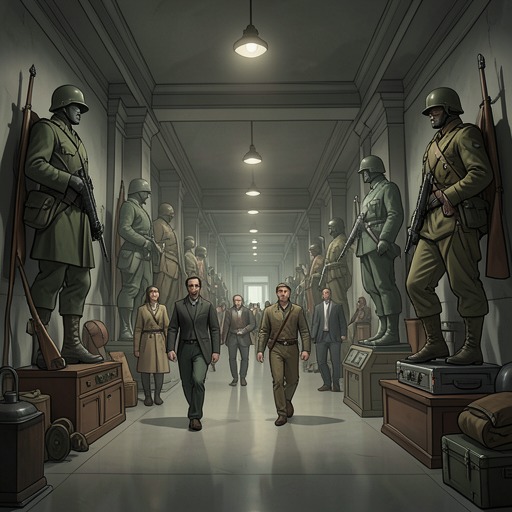
Inside, the guide points out a “Prooshious gunn,” a French gun, a flag, and the bullet that strikes it. The compressed sequence makes the exhibit operate like a child’s picture-book or a docent’s rapid inventory: each object is introduced in turn, but the labels’ comic spellings and sound collisions make the supposed clarity of the lesson unstable. The place promises access to history, yet presents history as a stream of verbal cues whose meanings keep shifting.
The Battle as Exhibit
The display centers on Willingdone, mounted on a large white horse and decked out in gold spurs, ironed armor, wooden shoes, and an elaborate assortment of costume-like equipment. Three “lipoleum” soldiers crouch in a ditch; named figures and troop types appear in quick succession, while the Alps and other landscapes become part of the same theatrical scenery. The guide’s repeated “This is” turns the battle into a tableau of labeled things rather than a continuous, authoritative account.
The opposing forces are rendered as “jinnies” and “lipoleums,” with weapons, dispatches, and troop movements reduced to noisy, mock-heroic set pieces. The jinnies feint and scheme, Willingdone’s side answers, and the troops alternately advance, fire, and scatter. A dispatch crosses the front in thin red lines; Willingdone’s “tic for tac” joke is followed by another exchange of taunts and orders. The sequence preserves the shape of conflict while making its grand language sound like a child’s game.
The battle’s reversals take material form in a hat. Willingdone first picks up half of a three-cornered hat from the mud and hooks it to the tail of his horse; the insult is then answered when the “seeboy” blows the fragment off. This recurring prop turns victory into a contest over gesture and humiliation. The exhibit closes with the guide’s declaration of how Copenhagen ended, folding the horse and the comic battlefield back into the tour’s inventory.
The Tour’s Frame and Tone
The episode is bounded by the visitors’ movement through the museum: they are told to mind their hats on entry and their boots on the way out. After the exit, the narrator’s voice remarks on the warmth inside and the cold air outside. That bodily transition punctures the grand scale of the battle display, returning the scene to the ordinary sensations of a guided visit.
The tour’s language continually mixes military vocabulary, place-names, accents, and invented compounds. Its sound effects and repeated labels do not merely decorate the account: they make the reader hear history as a clamorous, retold event, where apparent authority is inseparable from performance. A later exchange begins by calling the text a “claybook” and asking how its signs can be read; that description suits the Museyroom’s exhibit, where a world of history is built from signs whose meanings remain multiple and unsettled.
Historical Memory and Narrative Significance
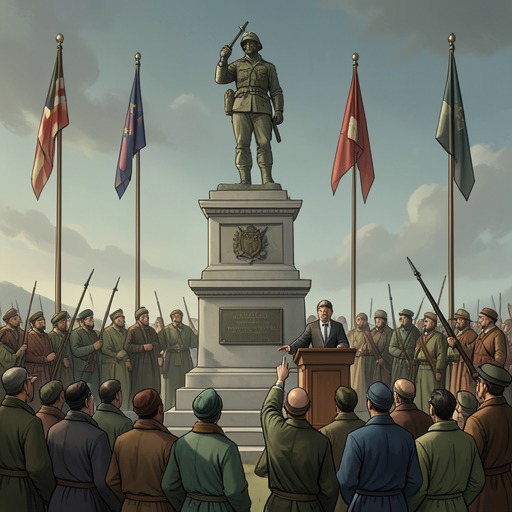
The Museyroom transforms a celebrated military episode into an unstable spectacle. Willingdone remains imposing in costume and mounted posture, but the guide’s brisk labeling, comic names, mock commands, and recurring hat joke prevent the display from settling into straightforward commemoration. The battle is simultaneously a public monument, a toy-like scene, and a verbal performance that can be rearranged as it is narrated.
This method links the museum to the book’s wider treatment of recurrence and reinterpretation. The opening associates the narrative’s movement with return, while the Museyroom makes the past recur as a sequence of recognizable yet distorted images. Its significance lies not in supplying a conventional account of Waterloo, but in showing how history, authority, and collective memory are continually remade through the language that claims to preserve them.